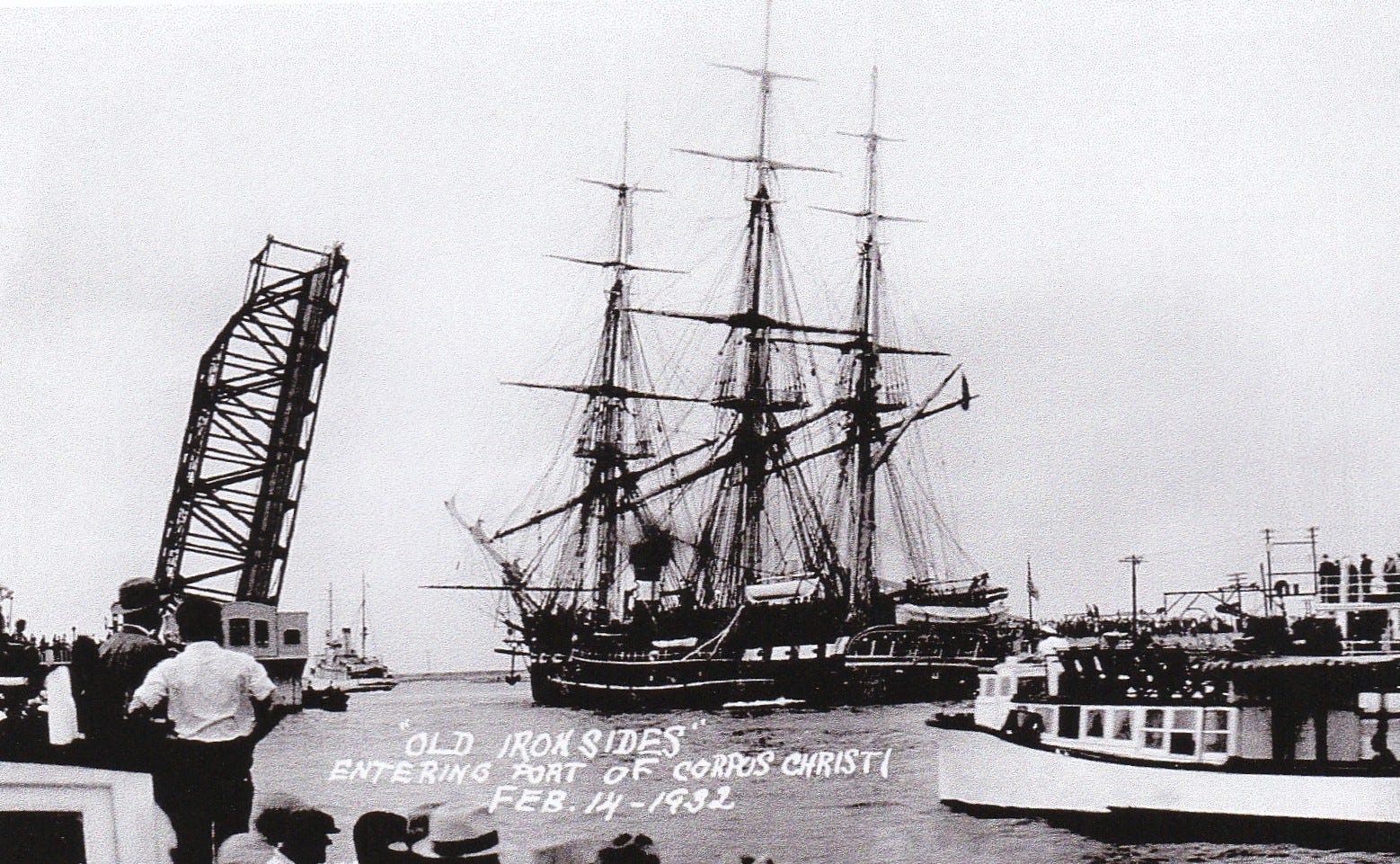
"Old Ironsides" Visits Texas in 1932
Following a Bit of Monkey Business on the Way
She didn’t fight in the American Revolution, but the U.S.S. Constitution has been flying the stars and stripes since 1797.
And in the winter and early spring of 1932, the historic warship, never defeated in battle, visited Texas for the first and only time. She called at the ports of Corpus Christi, Galveston, Houston, Galveston again, Beaumont, Port Arthur and Orange in that order.
In a mostly forgotten footnote to history, on the way to Corpus Christi from a Marti Gras visit to New Orleans, the captain and crew of the Naval vessel tasked with towing the Constitution from port to port first had to contend with some monkey business. Literally.
But before getting to the monkey tale, some background:
Famously known as “Old Ironsides,” the venerable three-master is the oldest commissioned warship in the world. Congress authorized the vessel in the Naval Act of 1794, a bill providing for the construction of six frigates to protect shipping from Barbary pirates in the Medeterrian. A heavy frigate with 44 guns, the Constitution slid down the ways at a Boston shipyard on Oct. 21, 1797.
Constitution went to work almost immediately after her commissioning, first taking part in an undeclared war with France and then participating in the bombardment of Tripoli in the fall of 1804. She went on to defeat two British warships and capture two others in the War of 1812. During that conflict the ship earned her “Old Ironsides” nickname when to the consternation of the British cannonballs bounced off her two-layer hardwood hull.
In 1830, when it appeared the ship might be scrapped, Oliver Wendell Holme’s penned his famous poem, “Old Ironsides.” That helped fan public sentiment to keep the ship afloat and the Navy had her refitted. Later, from 1844-1846, she logged 52,208 nautical miles in a cruise around the world.
When the Civil War broke out, she was still in service, but since 1860 had been relegated to training vessel status for Annapolis midshipmen.
Finally, she was retired from active service in 1881 and became a ship museum in Boston. By the time she turned 100 in 1897, the Constitution was well-established as a tourist distination. Though not totally neglected maintenance wise, by the 1920s she was leaking and sorely in need of a major workover.
Funded with pocket change collected by America’s school children, with additional private donations and an appropriation from Congress, a major overhaul between 1927 and 1930 got “Old Ironsides” ship-shape again. In the summer of 1931, the ship embarked on a three-year “thank you” tour of 90 American ports along the Atlantic, Gulf of Mexico and Pacific.
The old warship was fit for sailing under her own power, but there was one not-so-minor impediment: The U.S. Navy had no officers or sailors who knew how to navigate a sailing ship. Training a crew would take too much time, so the Navy assigned the USS Grebe—a World War One-era minesweeper—to take the Constitution in tow.
Now, about that monkey business.
The day before they were set to leave New Orleans for Texas waters, the crew of the Grebe discovered to their shock and dismay that their mascot, a two-year-old monkey named Rosie, had jumped ship. Or had someone Shanghaied her? Sailors scoured the Crescent City’s waterfront looking for their missing five-pound shipmate, but Rosie remained AWOL.
Despite the affinity they had for their little hairy fellow crew member, a playful creature who had deslighted children with her antics at previous ports of call, the captain and crew of Grebe had a schedule to meet. Casting her lines, the minesweeper and the historic vessel in her charge began the roughly 80-mile voyage down the Mississippi toward the Gulf sans Simian.
Meanwhile, New Orleans police received a call from someone who’d spotted a monkey calmly eating a lettuce leaf in the courtyard of a private residence. It was Rosie. The shore patrol rounded up the mascot and officials arranged to have her flown to meet up with the Grebe, which by that time had made it nearly to the Gulf.
Rosie arrived in a sea plane that landed near the ships. The Grebe sent out a launch and Rosie was piped back on board to the cheers of the crew lining her rails.
The ships reached Corpus Christi on February 14. A few days later, the Corpus Christi Caller-Times broke the story of Rosie’s misadventure. The unnamed reporter who wrote the piece ended it with this observation:
“Rosie is not the first sailor to miss a ship nor will she be the last, but unlike ordinary sailors it is doubtful that she will be hauled before the mast and reduced in rating or even tossed in the brig.”
By the time the Constitution departed the coastal bend on February 23, a total of 93,362 people had walked her deck during her South Texas visit. In the midst of the Great Depression, the presence of one of the world’s most famous warships proved an economic boon for Corpus Christi, which then had only 27,000 residents. The newspaper produced an ad-filled special edition, printing 20,000 extra copies, and local restaurants and hotels cashed in on the thousands of visitors who came to town. Railroads offered passengers special excursion rates.
On board the Constitution, visitors could buy and mail a specially printed commemorative envelope bearing a U.S.S. Constitution postmark. (Known to stamp collectors as cachet covers, they are highly collectable today.)
Beyond profiting from the visit, Corpus—well, one of its residents—gave something back. Mrs. Armstrong Price had an 1834-vintage miniature portrait of Josiah Fox, who designed the Constitution. Her father, she told the local daily, had been a close friend of Fox. While she apparently kept the painting, she allowed it to be displayed while “Old Ironsides” was in port and let the Caller-Times copy it. This was before newspapers used much color, so it’s in black and white:
When the old ship and her younger tender left Corpus Chrisit, she visited Galveston. Again, she got a lot of publicity, but no one reported the number of people who boarded her. From Galveston Grebe and the Constitution went up the Houston Ship Channel past the San Jacinto battlefield and tied up at Pier 2 in the Turning Basin. Roughly 11,000 people per day toured the vessel. Highways and trains leading to the Bayou City were jammed with incoming visitors.
By the time the Constitution left Orange on March 22, around a quarter million people had viewed the ship in Texas. Capt. Louis J. Gulliver said the 110,000 people who saw the ship in Houston was the largest turnout so far at any of the vessel’s prior ports of call.
Restored again in the mid-1990s, on July 21, 1997, the Constitution sailed under her own power for the first time in 116 years to celebrate her 200th anniversary. This time she had a Naval crew that knew the difference between a jib and a topgallant.
Stationed at the Charlestown Navy Yard in Boston, the Constitution remains fully commissioned, crewed by active-duty U.S. Navy sailors, and open to the public.