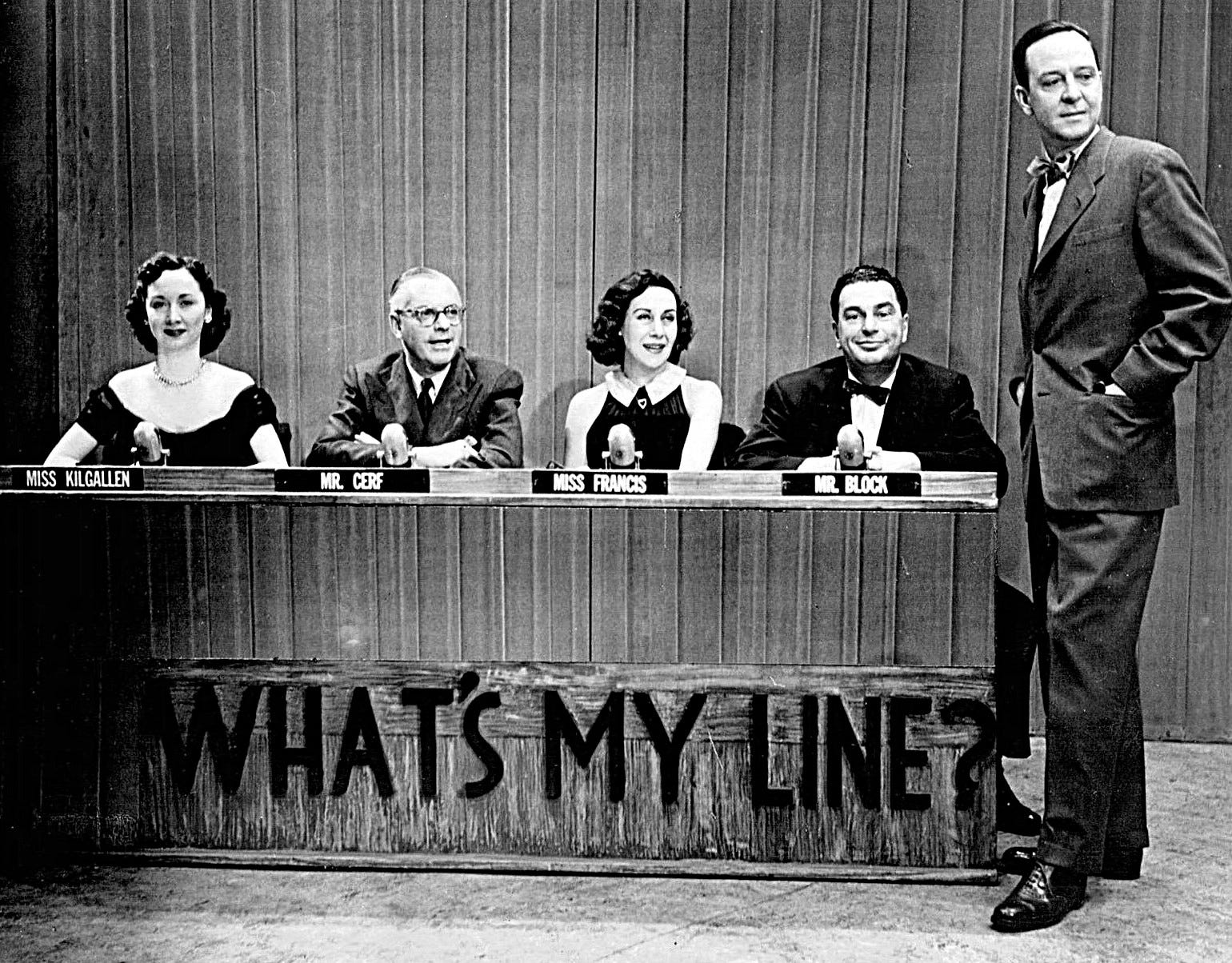
Remember TV's "What's My Line?" in the '50's?
A Memorial Day weekend reflection
Most Baby Boomers likely recall the 1950s black-and-white TV game show “What’s My Line?”
In it, a blindfolded celebrity panel tried to guess what each week’s mystery guest did for a living by asking them questions. Had the show survived until the 1980s, I bet I could have stumped the stars.
That’s because, for 15 years, I had a particularly unusual—and grim—way of observing Memorial Day and the other major holidays: I counted dead people for the state. Not people who’d left us in time of war, but people killed in vehicle crashes on Texas roadways.
Corpus Christi Caller-Times, July 7, 1986
Today, my endeavors—and those of others—are just an obscure footnote in the history of 20th century Texas public policy. Though I would not get involved in this until the Reagan years, at some point in the 1950s or early 1960s, someone with the Texas Department of Public Safety came up with the idea of a body-based traffic safety program called “Operation Motorcide.”
Here’s how it worked:
As one of the annual holidays approached, DPS number crunchers would estimate how many might die on the state’s roadways during that time. They did this for five of the Big 6 travel holidays: Memorial Day, Indepedence Day, Labor Day, Christmas and New Year’s. (For whatever reason, the department opted to skip Thanksgiving.)
A DPS public information person then wrapped the mortality guesstimate into a news release distributed to AP and UPI, the Texas State Radio Network and other media outlets across the state. Some years the DPS director would announce the number at a press conference.
This information always resulted in a flurry of media interviews, which afforded DPS spokespeople an opportunity to urge Texans to drive within the speed limit, not to drive at any speed while drinking and to be sure and buckle up.
Three times a day in the pre-internet era, a public information officer would drive (carefully) to the Austin DPS headquarters, sort through a stack of teletypes outlining the details of the latest traffic fatalities (both in those worked by the DPS and local law enforcement) and then do a news release reporting the number of deaths versus the department’s estimate. Each release or subsequent interview would come with a compliance pitch.
All this was based on the agency’s hope that all the media attention would help keep the final death toll below the worse-case estimate.
In June 1985, I went from writing about traffic deaths (and other police news) for the Austin American-Statesman to participating in Operation Motorcide as a civilian DPS employee. Later, I would run the program.
I handled my first Operation Motorcide the following July Fourth. That year the department estimated that 17 people would die on the state’s roadways, and as of midnight July Fourth, that was the number killed. However, after 12 a.m. July 5, two more people died in traffic mishaps.
The media liked to say that the DPS had “predicted” X-number of deaths, but it was just an estimate. If the death count exceeded the estimate, or fell below it, reporters would often ask why the department was off in its “prediction.”
July 4, 1994, was a day I’ll never forget.
In Texas, as elsewhere, most fatal traffic crashes involve only one or two victims. Any accident claiming more than five lives is considered catastrophic. Well, on this Independence Day, the DPS investigated THREE separate accidents that each left six or more people dead. Fourteen people, including 11 children, died on Interstate 20 near Weatherford when a tractor-trailer rig crashed into the rear of their van. Farther west, a collision in the Synder area killed 11 people. Finally, an accident in Runnels County left six dead. In all, 43 people died in that one 24-hour period.
All these year later, that still ranks as the bloodiest day in Texas traffic history.
At the beginning of my DPS career, going from paid question-asker to paid question-answerer had been novel. But that did not take long to wear off. While dealing with so much death is certainly not like experiencing a death in the family, it does take an emotional and to some extent, a physical toll.
Eventually, I began to feel uncomfortable being the voice of bad news during any given holiday. It began to seem to me like some in the media—and maybe even some of the general public—followed “Operation Motorcide” like some form of Roman-era spectator sport. Would the death estimate be reached? Would the count fall short? Would the number killed exceed the estimate? For all I knew, bookies were taking bets on the numbers I released.
Beyond that, time spent at the office in an otherwise mostly empty headquarters building reading reports of highway carnage, tallying the numbers and doing scores of newspaper, radio and TV interviews soon became odious. Not to mention the time it took me away from family, friends and all the enjoyable things I’d rather be doing. Like taking a nap without fear of my pager going off.
On top of everything else, I had come to believe that what we were doing wasn’t even working. I could not picture the average holiday reveler sliding behind the wheel of his car after just purchasing a six-pack, hearing me on the radio and suddenly thinking: “Man, that dude with the DPS says I shouldn’t be drinking and driving. Guess I’ll wait until I get home. And I’ll fasten my safety belt and drive safely.”
Not only did I suspect that my efforts and those of my fellow spokespeople were futile, I felt that the program, however well intended, was gouhlish. Surely a better way could be found to spotlight traffic safety.
In 1991 I got promoted and took charge of the public information office. As what the org chart at that time grandly called “Chief of Media Relations,” I reported directly to the DPS colonel. I kept soldiering on with Operation Motorcide, along with my colleagues, but in June 2000—just in time to free up my staff’s Fourth of July—I succeeded in talking the colonel into 86-ing the decades old corpse-counting program.
Meanwhile, our office continued to preach the Holy Trinity of Traffic Safety:
Don’t speed
Don’t drink and drive
Buckle up.
These days, those who’ve followed me in the public safety-public information field add a fourth warning: Stay off your cell phone while driving.
I’d like to think that our long-ago “Operation Motorcide” efforts did save some lives, but being able to prove that is about as likely as accurately assesing how many people will die on our roads and highways in any given time frame.
May “Operation Motorcide,” and the hundreds of traffic victims whose names my co-workers and I reported to the media in the name of public safety, rest in peace.


I remember those day.s. I would be on TV and radio preceding the holiday. I also enjoyed . working with you and the others.