Remembering T. Lindsey Baker
When the email from the West Texas Historical Society popped up in my inbox at 3:21 p.m. Friday, the subject line said only, “T. Lindsey Baker.”
Email like this seldom brings good news. “Maybe he’s getting some kind of honor or has another book out,” I hoped.
But I knew it wouldn’t be that.
Dr. Baker—the 79-year-old author of 21 solid Texas books focusing on the state’s history and culture—died Thursday in Flagstaff, Arizona. He had many friends and acquaintances, and I’m one of them.
The email came from writer-historian-newspaper publisher Barbara Brannon of Spur. She’s president of WTHA this year. First news of his death did not come with any details of what happened to him.
But I know what he’d been up to, and there’s a lesson in it for all of us: He was doing something he loved.
More specifically, as owner of a fire engine red 1930 Model A, he was a member of the caravan organized as part of the 100th anniversary celebration of the storied roadway formally known as Route 66 and affectionately known as the Mother Road. This would have been Baker’s fourth drive-through of the old highway.
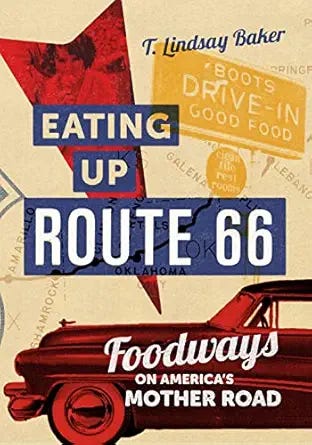
Two of Baker’s books deal with Route 66: Portrait of Route 66: Images from the Curt Teich Postcard Archives (2016) and Eating Up Route 66: Foodways on America’s Mother Road (2002)
The caravan, maybe a record-length parade, left Santa Monica, California on June 6 and is scheduled to reach Chicago on June 25. Baker’s death will probably alter the schedule.
I don’t remember offhand the first time I met him—probably when I was covering an annual meeting of the Texas State Historical association back in the 1980s—but I certainly remember the last time.
I was in Amarillo a year ago this month attending the Western Writers of America annual convention. Beverly and I sat in on a presentation Baker gave on good eats along the stretch of asphalt extending from Illinois to California.
It was an interesting, funny talk as was every talk of his I ever attended.
After his presentation, I visited with him a bit and asked a favor: Would he take a look at the manuscript of my then forthcoming book, “I’ll Take the Chicken Fried Steak.” And if he liked it, would he write a blurb for the back cover?
“Oh, what a fun idea!” he gushed. “I’d be happy to.”
Not that he did so in a hurry. But he did email me a blurb, and it’s on the back cover of my book.
The last time I heard from him was October 18 when he emailed me his snail mail address so I could send him a copy of the book. He told me he’d just gotten home from his third pilgrimage along the mixture of original portions and modern roadways that trace the path of old 66.
“Yesterday I returned by Amtrak from Los Angeles and a 2,500-mile trip down the historic pavement of old Highway 66 from Chicago,” he said in his email. “It was a three-week sojourn with seven other 1928-1931 Ford Model A cars and drivers who converged on the Windy City on the 22nd of September. What an enjoyable time we had!”
I am sure that Baker had moments in his life when he wasn’t able to laugh and smile, but I never saw him when he didn’t seem like the happiest guy in Texas or anywhere else.
Recently retired as a Tarleton State University history professor, and former director of the W.K. Gordon Museum and Research Center for Industrial History of Texas (located at the ghost town of Turber) Baker got his kicks on Route 66 and just about anything else in life.


When T. Lindsey was director of something at the museum in Canyon I was editor of the town's paper, and we became associates. He was remarkably persuasive as well as knowledgeable. He got the museum to let him literally, meaning really, build a sod house as it would have been constructed and furnished in 1907. He wanted to actually bust out the sod on completely virgin land on the WTSU Nance Ranch. He did. Boy Scouts helped him. He built the one-room house of sod. Then, T. Lindsey being who he was, he wanted to live in it. He talked me into spending the weekend one February with him. I've never been treated so warmly and been so freaking cold in all my life before or since.
Thank you, Mike. I still use his “Ghost Towns of Texas” whenever I go ramblin’.