Rewriting History in Central Texas
By Mike Cox and Erica Marcoux
Pop quiz!
What and where is the oldest known architectural structure in the Americas?
Bonus points:
Where have the oldest known engravings (as art objects) been found?
Since this isn’t a real test, let’s start with all the historical man-made works that are NOT the oldest in North America:
· The Taos Pueblo, c. 1000-1450 CE (New Mexico)
· The Acoma Pueblo, c. 1150 CE (NM)
· The West Oak Forest Earthlodge Site, c. 1250-1400 CE (Mills County, Iowa)
· Mesa Verde Cliff Dwellings, c. 1190-1300 CE (Colorado)
· San Miguel Mission, 1610 (Santa Fe)
· Palace of the Governors, 1610 (Santa Fe)
· Fairbanks House, 1641 (Dedham, Mass.)
· Whitfield House, 1639 (Guilford, Conn.)
· Jamestown Church Tower, 1639 (Jamestown, VA)
· Nothnagle Log House, 1638-1643 (Gibbstown, NJ)
Ancient as these architectural structures are, they may as well be 1930s Art Deco-style buildings compared to what is now believed to be the oldest known human construction project in North or South America.
And that piece of architecture lies (quite literally) deep in the heart of Texas.
It’s a man-made stone floor or “patio” fashioned of fitted rocks and gravel fill found some 10 feet underground. This ancient floor is located a little over 6 miles from Florence along the boundary between Williamson and Bell counties. Archeologists believe it is roughly 20,000 years old.
The estimated date is based on artifacts found in situ beside and underneath the crude pavement. Archeologists believe these stones were laid down to create a clean and dry surface roughly 10 by 10-foot. They found no evidence of postholes around it that would indicate wooden pillars that would have been necessary to support a roof or walls. What purpose this flooring served remains a mystery.
The discovery of the mysterious stonework and artifacts at this site is the most recent overturning of the long-accepted theory of human existence in the Americas.
Like an archeological dig, the story is best understood by uncovering it layer by layer.
In the beginning, or so it was long supposed, Asians crossed the Bering Strait land bridge from Siberia to Alaska during the Ice Age. This is supposedly when humans first came to the Americas, around 13,000 years ago. All of this happened before recorded history, which dates back a mere 3 millennia.
What drew early humans to Central Texas was the availability of what humans still depend on today—water, food and tools. Once they discovered the spring-fed waters of what is now known as Buttermilk Creek, ancient nomadic peoples occupied the oak and pecan-shaded valley off and on for thousands of years.
Naturally, they left behind what to them was trash. Their organic waste is long gone, but their lost or abandoned stone tools—knives, dart points, spear heads and other iron-hard, chipped-chert necessities—remained. So did the partial remains of at least one mastodon, killed, butchered and eaten at the site.
It’s been known since at least 1909 that the Buttermilk Creek valley was a significant archeological site. University of Texas (UT) archeologist Dr. J. E. Pearce directed the first crude (by today’s standards) excavation there in 1929.
After that, the landowners began accepting money from amateur relic hunters, making it, in archeological speak, a “patronage” site. Untold numbers of artifacts were lost to science, ending up either in a cigar box, as framed arrangements on the walls of collectors, or scattered by in-person and online selling.
In 1990, one amateur digger found two etched stones. He sensed that they might be important and reached out to Dr. Thomas Hester, then director of the Texas Archeological Research Lab (TARL) at UT. Intrigued, Hester and the lab’s associate director, Dr. Michael B. Collins, got permission from the landowner to take a new look at the site.
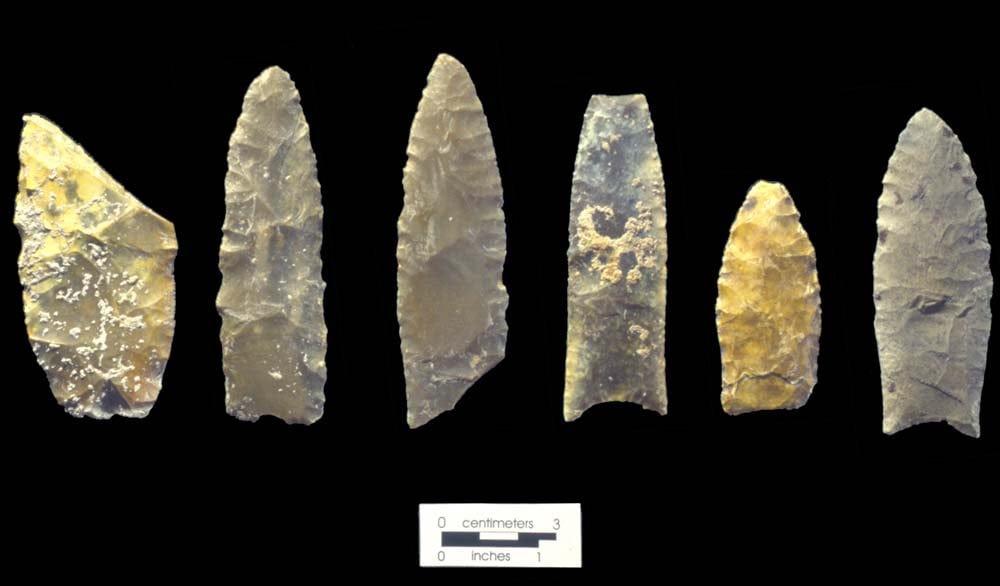
They did and in 1991 Hester and Collins found more etched stones as well as a flint artifact known as a Clovis point. First discovered in 1956 near Clovis, New Mexico, this type of point was long regarded as the oldest style of prehistoric tools. And for decades, archeologists believed the points had only been used in the Southwest. But since then, Clovis points have been found across the continent, even on the East coast.
One of the interpretive panels at the Gault site shows the progression of stone tools. Photo by Erikia Marcoux
Seven years later, new owners of the property ended the “pay-to-dig” looting and allowed another test exaction at the site. The following year, 1999, a series of major excavations began that continued until 2015, the most recent dig. That last dig is the one that revealed the early village “square.”
The work revealed deeper pre-Clovis layers before reaching bedrock, drastically changing the historical landscape. Humans were indeed in the Americas 20,000 years ago.
In addition to the discovery of the ancient flooring (which was covered after the investigation concluded), the 176 hand-engraved stones found at the Central Texas site are the earliest known positively dated engravings in North America. And therefore, the earliest American artwork.
To date, the Gault site—which Dr. Collins purchased in 2006 and donated to the Archeological Conservancy—has yielded some 2.6 million artifacts revealing 22 distinct archeological cultures. Yet only 3 percent of the site has been scientifically investigated. Who knows what other secrets the banks of Buttermilk Creek may still hold?
To schedule a tour of the Gault site, now the Gault School of Archeological Research, go to www.gaultschool.org. Tours are $20 for those 13 and older, $10 for children 9 to 12. Tours begin at 10 a.m. and last about two hours. Water is available on site, but far smarter to pack your own. It’s an easy hike, with frequent stops for presentations by the guide. That said, I took my favorite walking stick and didn’t regret it.
Editor’s Note: Proud to add bonus daughter Erika Marcoux’s byline to this article. She and her husband David toured the site with me, taking notes and photos. Later she contributed some of the text and edits. Erika graduated from the University of Texas at Austin with a degree in archeology and anthropology and a minor in photojournalism. She took one of Dr. Hester’s classes and volunteered at TARL.