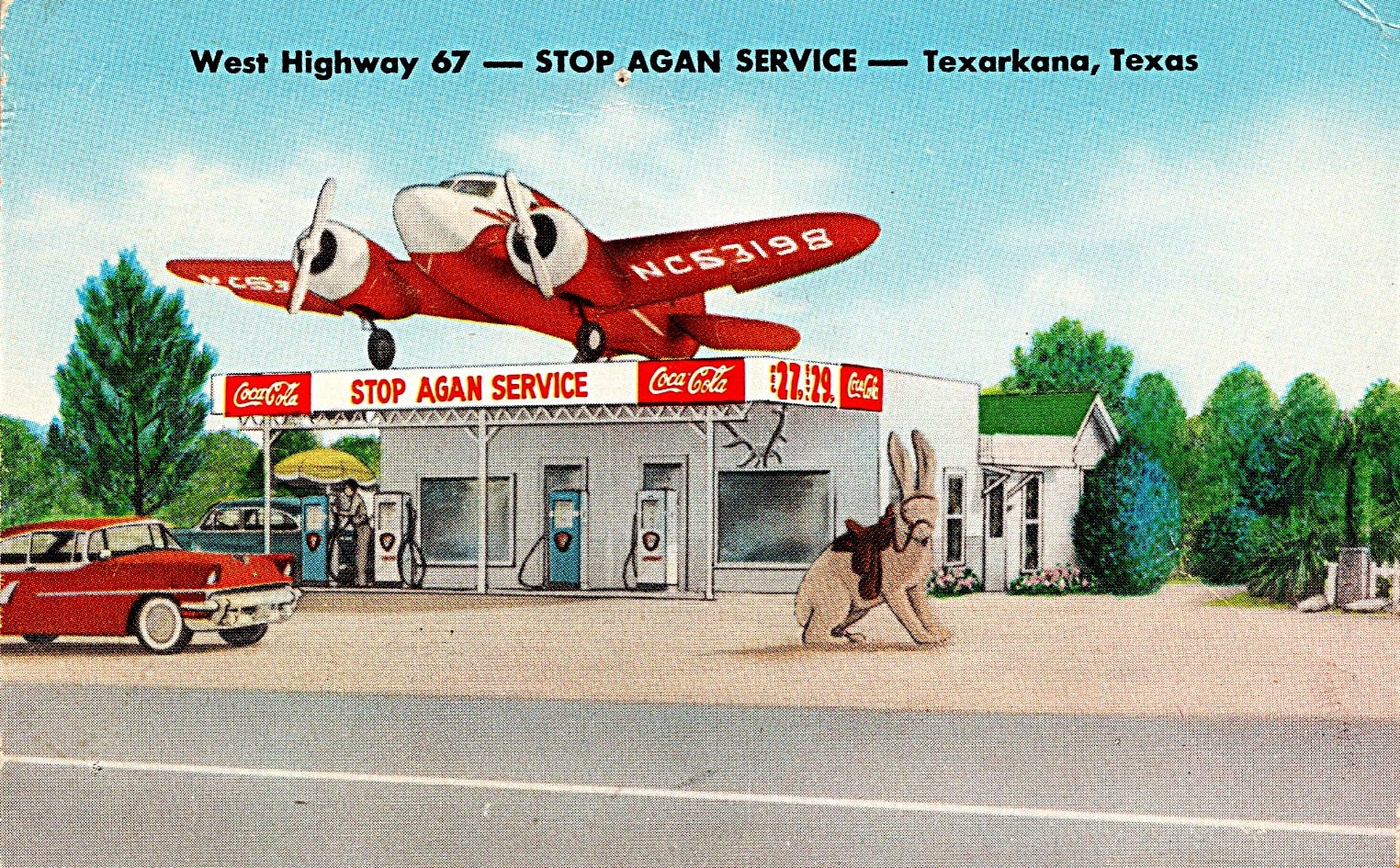
Route 66 + 1: The Story of U.S. 67
People still get their kicks on old Route 66, but Route 66 plus one—U.S. 67—still’s stomping as a multi-state transportation coridor.
It may not be the Mother Road, which as of 2026 is a century old, but U.S. 67 stretches 1,560 miles across five states, connecting Iowa to Mexico. (By comparison, Route 66 is 2,448 miles long.)
U.S. 67 extends through Texas, Arkansas, Missouri, and Illinois to the intersection of U.S. 52 in Sabula, Iowa, population 498.
Six hundred thirty-seven miles of U.S. 67 are in Texas, from Texarkana to Presidio on the Rio Grande. Most of the Texas roadway is four-lane, some of it four-lane divided highway, though south of San Angelo, it is predominantly two lanes.
U.S. 67, in red, crosses Texas from the East Texas pines to the Rio Grande.
People get shorter as they age, and so do highways. U.S. 67 originally covered 1,634 miles. Over the years, highway engineers have shaved 74 miles off the roadway by straightening kinks.
For example, orginally, the highway made an inverted V from Santa Anna to Coleman and then back to Valera. Back in the 1960s, the Texas Department of Transportation connected the dots from Santa Anna to Valera, transforming the old section of U.S. 67 south from Coleman to Highway 206.
One of 45 U.S. highways in Texas, work on the Lone Star segment of U.S. 67 started in 1927 when it was extended from Fredericktown, Missouri to Dallas. In 1930, TxDOT began developing the route from Dallas to Presidio.
The highway reached Brownwood in 1932 and had been completed to the border by 1934.
That doesn’t mean that U.S. 67 was a seamless ribbon of pavement from Brownwood to the Big Bend, or from Big D to Little B when it first opened. A 1932 map shows the south-bound pavement from Brownwood played out just past Talpa. From that small community, the rest of the way to San Angelo was what the map’s legend referred to as a second-class road, “gravel or graded all weather.” The pavement picked up again at Ballinger and continued through San Angelo.
West of San Angelo, the pavement ended again about halfway to Mertzon, with hard surfacing not resuming until the Upton County line. From there, a motorist could enjoy smooth driving to McCamey. After that, except for a brief stretch near Alpine, U.S. 67 ran unpaved all the way to Presidio.
North from Brownwood, the pavement ended at the Comanche County line and didn’t resume until Hood County. From tiny Bluff Dale, drivers could count on pavement all the way to Texarkana.
When TxDOT engineers first began designing a highway system in 1917, some of the routes they selected for pavement had evolved from animal trails to wagon roads to graded roads. In other instances, engineers planned roadways paralleling railroads. Much of U.S. 67 was new roadway surveyed adjacent to the railroad tracks from Dallas to Brownwood.
Beginning between Santa Anna and Coleman, the highway parallels the old Orient Railway, which came from Kansas City to Presidio via San Angelo and Fort Stockton in 1911.
From 45 mph to 80 mph
By the 1930s, Texas had a respectable highway system, but traveling still was not as easy as it is today. The speed limit had been raised to 45 miles an hour in 1928, and held there until 1941, when the Highway Commission bumped it to 60 mph. That lasted until 1942, when war time shortages forced a reduction to 35 miles an hour to conserve gasoline, oil and rubber.
At the end of the war, the speed limit went back to 60, where it stayed until July 1963. That summer it went to 70, the limit until another gasoline shortage in 1974 resulted in a slowdown to 55 that held until the speed went back to the present 70 to 80, depending on the roadway.
Five bucks for a barrel of water, $1 for a barrel of oil
In addition to speed limit fluctuations, U.S. 67 has seen a couple of Golden Eras. The first came during the latter heyday of Big Lake, Rankin and McCamey, with oilfield activity at its peak. Back then U.S. 67 was the road to prosperity, with a lot of traffic in and out of the oil patch. Just to show how things change, when McCamey had 10,000 people, water was worth more than oil. H2O was hauled by train from Alpine. It cost about $5 a barrel, compared to a dollar a barrel for oil.
On U.S. 67, Big Lake’s Mustang Motel had a few “stables” available for the night
The second U.S. 67 boom came during World War II, when Brownwood’s Camp Bowie served as a major Army training facility. GIs who did not reach Brownwood by train came in on U.S. 67.
The Big Bend Trail Association
After the war, a group of transportation and tourism proponents organized the Big Bend Trail Association, a non-profit corporation headed by Claude W. Meadows of San Angelo. The group touted U.S. 67 as the prime route to the new Big Bend National Park and advocated a continuation of the highway to Chihuahua City in Mexico and from there on to South America.
“Along the route of U.S. 67,” Texas Parade magazine said in 1952, “is a loyal and devout group of representative businessmen who believe in their hearts that the Big Bend Trail is one of the greatest boons that has come…to the Southwest.”
No matter the beliefs of businessmen, with the completion of Interstate 10 in the early 1970s, traffic on U.S. 67 west of San Angelo dropped considerably. A decline of oilfield activity between Big Lake and McCamey brought a further reduction in traffic, particularly from San Angelo to the I-10 intersection outside Fort Stockton.
The Big Bend Trail Association eventually changed its name to the U.S. Highway 67 Association and continued to promote the route, publishing a four-color brochure touting U.S. 67 as “The Big Bend Trail” and “Family Vacation Route.”
Where was Nat King Cole when U.S. 67 needed him?
Despite the best efforts of the now-defunct organization, U.S. 67 never received the kind of press Route 66 enjoyed. John Steinbeck’s classic novel The Grapes of Wrath, Nat King Cole’s song “Get Your Kicks on Route Sixty-Six” and the early 1960s TV show, “Route 66,” assured the highway’s place in popular culture.
In Texas, I-40 replaced the storied Mother Road in July 1984. (As the interstate also did in Oklahoma, New Mexico, Arizona and California.) By 1985, the few TxDOT Route 66 signs that had not been stolen went to Austin for public auction.
How cool is Route 66 memorabilia? Recently, a beat-up U.S. 66 sign was for sale on eBay for $1,699.95 “or best offer.”
Unless U.S. 67 morphs from meat and potatoes asphalt and concrete infrastructure to a cultural icon like Route 66, its signage is likely to remain unmolested except perhaps for the occasional bullet hole along the road’s lonelier stretches.