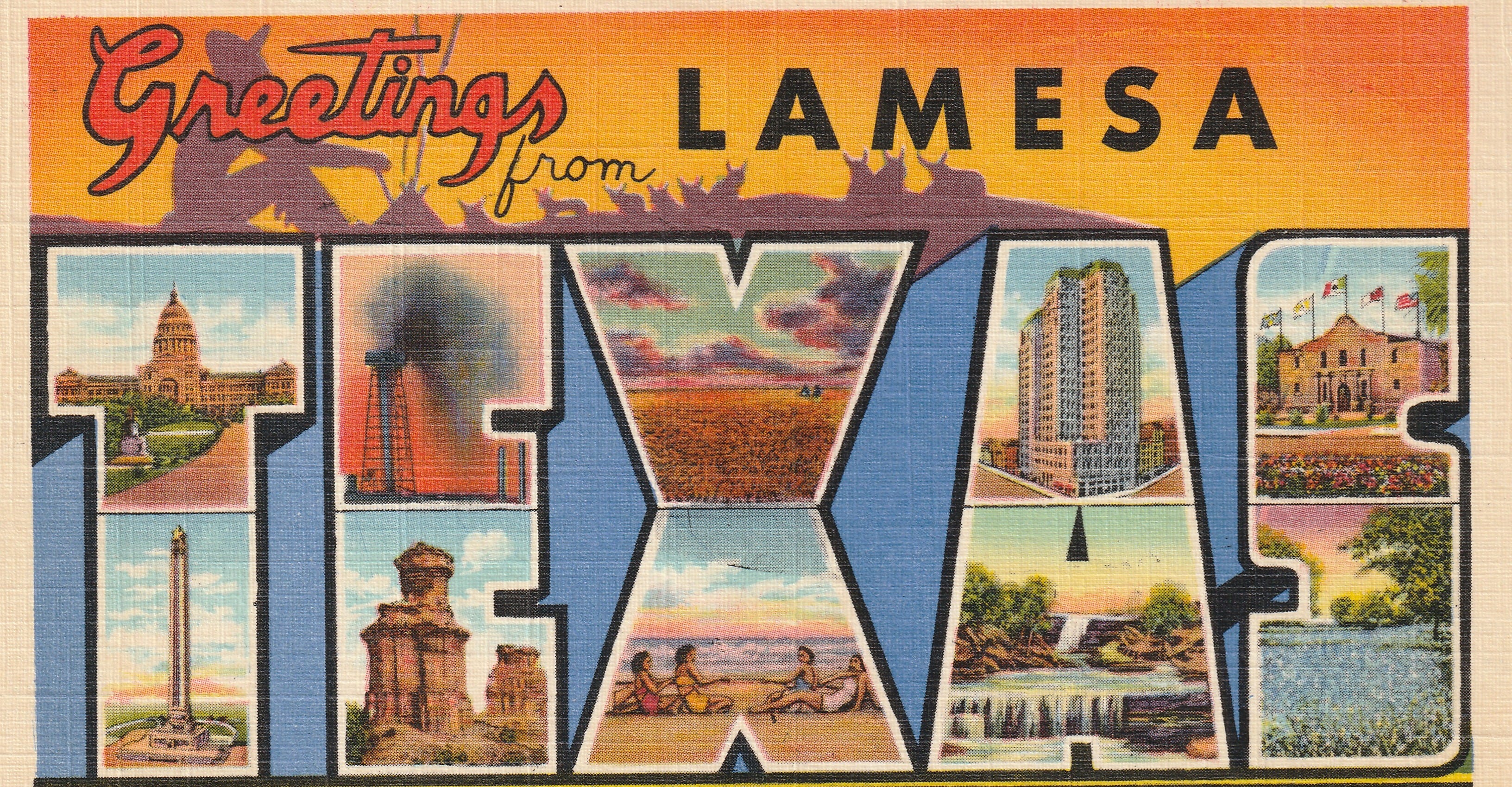
The Lamesa Incident
Future Pulitzer Prize winner Larry McMurtry wrote an essay back in the 1960s about a trip he took across Texas.
Related in his book In a Narrow Grave, his experiences may or may not have been true, but one of his sentences stands the test of time:
“Only a rank degenerate would drive 1,500 miles across Texas and not eat a chicken fried steak.”
Recently, my friend Wayne Jackson and I covered at least two-thirds of that mileage in West Texas hoping to peddle copies of my 2025 book (with contributions by Larry BeSaw and Wayne) on chicken fried steak. From Blue Hole Press, “’ll Take the Chicken Fried Steak” exposes how a half-century-old newspaper gag led to the lingering myth that chicken fried steak was invented in 1911 in Lamesa, Texas.
Assuming we’d soon be autographing numerous copies, it never occurred to me that I’d end up essentially getting kicked out of this South Plains community that proclaims itself the Chicken Fried Steak (CFS) capital of Texas.
As I explained in an earlier post, and in much more detail in the book, my longtime buddy Larry, now retired, created the Lamesa CFS origin tale out of whole cloth.
The story appeared as a point, counter-point package on the front page of the Austin American-Statesman’s Lifestyle section in January 1976. The piece, and a snobby anti-CFS article that I wrote, generated a lot of laughs and favorable letters to the editor.
That would have been that, but six months later Texas syndicated columnist Jack Maguire stole the story without any attribution. Worse, he told it for truth.
The Legend Begins
A legend was born. Eventually even the Smithsonian Magazine proclaimed it as true. So did many other publications and individuals. If you doubt that, just Google the terms “chicken fried steak” and “Lamesa, Texas.”
In January this year, I reached out to the Lamesa Chamber of Commerce, which sponsors Lamesa’s annual Chicken Fried Steak Festival. I said I’d like to be a vendor to sell and sign copies of my book. Further, I’d be happy to give a talk about it.
When I hadn’t heard anything definitive by early April, I called chamber director Dora Armendariz. I guess you could speak at our annual chicken fried steak supper, she offered.
Accordingly, awash with optimism, I filled out a vendor application and mailed it and a check for $80 to the chamber.
A few days later, prepping for my speech, I called Larry and asked a question that somehow, I’d never previously thought to pose: Why did you pick Lamesa of all places as the fictional birthplace of CFS?
“Well, it’s a story you can’t tell there.”
“Whaddya mean?” I asked.
“You’d get run out of town,” he responded.
“So, what’s the reason?” I followed.
“Well, if you’ll recall, in 1974, you and I went to Lubbock to see UT play Texas Tech,” he began. “On our way back to Austin, we stopped in Lamesa for gas. And when I got out of the car and looked around, I remember thinking ‘What a desolate, godawful place. Thank the Lord I don’t live here.’”
He continued: “When I wrote the chicken fried steak story, I wanted to set it in the most forsaken, backwater place in Texas I could think of. And that was Lamesa.”
A Brief History of Lamesa
Platted in 1904, only seven years before the alleged CFS Big Bang at a café called Ethel’s Home Cooking (so named because that’s where Ethel always was when anyone asked), Lamesa was named for a familiar South Plains geologic feature—the mesa. “Mesa” is a Spanish word, so the correct description in that language would be “La Mesa.” The town folks opted for “Lamesa.”
A transportation crossroads and cotton-growing center, Lamesa hit its peak population in 1960, when Census enumerators found 12,438 residents. After that, excepting a 231-person growth spurt between 1970 and 1980, the community has steadily lost population. The 2020 census found 8,393 residents. One online source says the number is now even below 8,000.
Sixteen years ago, someone in Dawson County came up with the idea of capitalizing on Larry’s made-up tale and began an annual spring celebration of CFS. It features vendors selling everything from made-in-China toy hanging monkeys and plastic bubble blowing guns to tacos to knives. There’s also a CFS cooking contest and live music. The official festival mascot is a white chicken named Perkins. That’s the last name Larry gave to his fictional CFS originator, Jimmy Don Perkins.
That the celebration is based on fake news is not new news. The word-rustling by Maguire and the subsequent perception that CFS had been invented in Lamesa has long since been exposed.
In fact, one year festival organizers invited Larry to come to Lamesa and tell the story behind his fake history. Larry, perhaps remembering his brief previous visit, graciously declined.
By way of fair play, one notable dish did happen to be developed in Lamesa. The Sky Vue Drive-In, opened there in 1948, served something called a Chihuahua sandwich that became a regional favorite. By 2015, the drive-in—Buddy Holly once played there during the run-up to show time—was one of the last outdoor theaters in Texas. But when fire destroyed its kitchen that year, the owners closed the business. The screen was taken down in July 2024 and other features removed.
Driving past the site of the former drive-in, Wayne and I hit town late in the afternoon on Thursday, April 23. We checked into an early 1980s vintage motel called the Shilo Inn, an accommodation named for a Civil War battle that occurred only 889 miles from Lamesa.
George Strait
The next morning as we ate breakfast, the front desk person cheerfully asked if we were in town for the George Strait concert. Of course, the country music star would be playing that weekend at Jones Stadium in Lubbock, not Lamesa. But Lubbock was sold out, and so were the motels in Lamesa, which is 60 miles south of the Hub City. (Even so, we were paying at least half-again the normal room rate.)
When we explained why we were in Lamesa, the lady said she’d sure like to buy a copy of the book. After we finished breakfast, I went out to my SUV and got her a copy. She paid $20 cash and I inscribed it to her.
Then I decided to use her as a one person focus group to try out one of the jokes I planned to tell in warming up the crowd that night.
“You know, George Strait wrote a song based on me,” I began.
“Really?”
“Yes. I was born in the next big city north of Lubbock,” I began. “In 1962, my dad sent me a Greyhound bus ticket so I could visit for Christmas. We left Austin about dark and it was an all-night trip. The sun was coming up when my dad met me at the bus station.”
“What’s the song?” the lady asked.
“Amarillo by Morning,” I replied.
We’d toted a box-and-half of books to Lamesa, but this local woman would prove to be our only customer.
From the motel we went to the chamber office. The director, a Lamesa local who rose from office manager, told me that some 6,000 people attended the first day of activities the year before, with another 12,000 the second day.
As we talked, I did a brief mental calculation: Should that many people show up this year, if only half of one percent of those folks possessed sufficient intellectual curiosity to purchase a copy, we would sell all the books we’d hauled to West Texas.
About mid-afternoon Ben Terry, the outgoing manager of local radio station KPET, interviewed me about the book, stressing that copies were available at the festival or via Amazon. He generously touted my upcoming talk and said attendees could get the book there, as well.
Alas, while the people watching that afternoon proved mildly interesting, Wayne and I manned our spot behind the courthouse until about 5 p.m. without a single sale. Only two couples stopped to see what we had to offer, and neither bought a book.
Having been in the wind and sun for much of the day, we left our spot (marked by my name written by a festival volunteer in pink chalk on the nearby sidewalk) to get cleaned up for the CFS supper.
Arriving at the venue shortly before 6:30, we talked with Dora about the best place to display the books and promotional t-shirts we’d ordered. We got everything set up and at 7 p.m. got in line for the catered CFS meal
Wayne, unable to get CFS in Tucson, wolfed down his steak. I only ate part of mine, which was tougher than an oilfield roughneck. On top of that, the peach cobbler came in a plastic cup not much bigger than a shot glass.
Initially Dora said she’d handle my introduction but later returned to our table and said she thought it’d be better for a member of the chamber board to handle that duty. Whatever you’d like, I said.
The Doctor Will See You Now
Directly, board member Dr. Isabel Molina, a local physician, came to our table. With her cheeriest bedside manner, she greeted us and said she’d be introducing me.
I picked up a copy of the book and showed her the brief author’s biography on the back cover.
“You can just read that,” I said. “I don’t need a long, drawn-out introduction.”
But perhaps due to her clinical observation skills, she read the description of the book first. Her eyes widened.
“You’re debunking the Lamesa chicken fried steak story?”
“Yes,” I said, “It was all just a joke, which is explained in the book. But I’m all for your festival. We never have to have much of an excuse to celebrate in Texas and I’m sure Lamesa needs all the tourist revenue it can get.”
But the doctor’s demeanor had clearly changed. I began to sense that what the medical profession euphemistically refers to as a “bad outcome” was in the offing for my scheduled appearance.
Clearly flustered, Dr. Molina excused herself, saying she’d be back in a minute. Meanwhile, Wayne and I sat at our table, watching the crowd slowly diminish. No one looked in our direction or came by to check out the books and t-shirts piled behind us.
More than a minute went by before the doctor returned. This time she looked like she was about to deliver very bad lab result news.
“I’m sorry,” she said. “But I can’t introduce you”
Before I could say, “But…but…but…” she said, “Have a nice evening,” turned around, and quickly walked away.
Stunned that a 50-year-old joke, long since exposed as mere flight of fantasy on Larry’s part, could get me canceled at the last minute in Lamesa, I hurried next door to the chamber office hoping to plead my case. I wanted to tell her that the last time I’d visited Lamesa, I’d found a framed copy of the original BeSaw-Cox story displayed in the Dawson County muse
um.
I couldn’t find the doctor but caught Dora, who said she had to follow what “my board” said. I knew I had become persona non grata when she started referring to me as “sir.”
Over a long career as a writer, I’ve given hundreds of talks in Texas and across the nation. But this was the first time I’d been given the hook. And before I could say one word.
Ironically, I’m not the first member of my family to find it expedient to get the heck out of Dodge…I mean, Lamesa. In the early 1950s, my father Bill G. Cox was a reporter for the town’s paper, then an afternoon daily. He and a representative of the local constabulary had a misunderstanding regarding the letter and the spirit of the law dealing with consumption of adult beverages. The police arrested him. When he got out of the hoosegow, his boss opined that his journalistic talents would perhaps be better appreciated in his hometown of Amarillo and fired him.
At least I didn’t end up in jail.
Early Saturday morning, Wayne and I drove back to the courthouse to pick up my chairs and the table we’d borrowed. After returning it to the owner, with apologies to the late country singer Mac Davis, “Happiness was Lamesa, Texas in my rearview mirror.”


Y'all hit the nail plum on th head! Terrific!!!
Great story. That is sort of my experience with West Texas. They are all welcoming and happy to see you then you say or do something that brings it home to them that you aren't one of them and then they don't have any use for you. Anyway, long ago, I visited an old Meemaw and her CFS was to die for. So was the pepper gravy.
I have relatives still in West Texas. But I avoid spending too much time there.